I keep a BlackBerry Bold 9700 on my desk. It shipped in 2009, runs BlackBerry OS 5, and has a trackpad that still feels better than it has any right to. I did not buy it for nostalgia. I bought it because it is one of the cleanest teaching tools I have found for understanding how cellular networks actually work, and why the security model we rely on today looks the way it does.
Most of my work lives in cloud detection and Active Directory. Cellular felt like a black box for a long time: my phone connects, calls happen, and the radio layer is somebody else's problem. That is a bad place to leave a gap when so much of identity and MFA now rides on SMS and phone numbers. The Bold 9700 is a 2G/3G-era device, which means it exposes the older, simpler protocols that the modern stack was built to fix. Studying the broken version first is the fastest way to understand why the fixed version exists.
The device is a map of the cellular stack
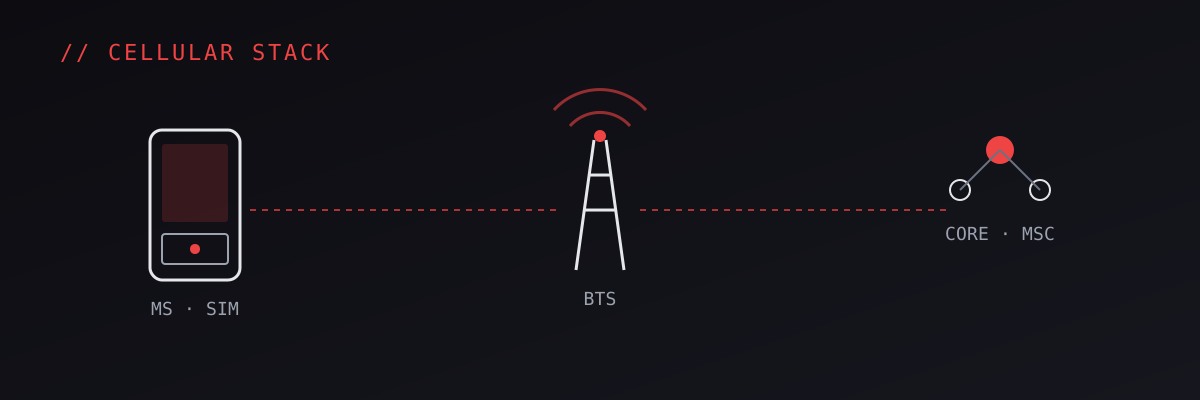
In cellular terms the phone is the Mobile Station, and it splits into two parts: the Mobile Equipment (the handset, identified by its IMEI) and the SIM (identified by the IMSI). That split is the whole point. Your identity lives on the card, not the hardware. Pop the SIM into another phone and the network treats you as you. Swap SIMs and the same handset becomes someone else. Holding a phone with a removable battery and a bare SIM slot makes that separation obvious in a way a sealed modern phone never does.
From there the chain is: the phone talks over the air to a base station (BTS), base stations aggregate into a controller (BSC), and controllers feed the core network (the MSC and its registers) that handles authentication, routing, and billing. Every acronym maps to a physical or logical box you can reason about. Once I could draw that chain from memory, cellular stopped being a black box.
The SIM is a tiny authentication server
The most useful realization was that the SIM is not storage. It is a smartcard running a small application, and it holds a secret key (Ki) that never leaves the card. When the network challenges the phone, the SIM runs the challenge through its key and returns a response. The network checks the response against its own copy of the key. The handset is just a courier. This is a real challenge-response authentication scheme, and it is the same shape as things I work with every day: a shared secret, a challenge, a computed response, and a secret that is supposed to stay in a tamper-resistant boundary.
You do not need to attack anything to see this. You can talk to the modem directly over its AT command interface on a device and SIM you own:
AT+CIMI      # read the IMSI (subscriber identity) from the SIM
AT+CGSN      # read the IMEI (equipment identity) from the handset
AT+CGMI      # read the modem manufacturer
AT+COPS?     # show the currently registered network operator
These are standard, documented commands. Running them on my own phone made the IMSI/IMEI split concrete: two identifiers, two owners, two trust boundaries.
Where the 2G model breaks, and why it matters
Here is the lesson the Bold 9700 teaches better than any diagram. In the original GSM (2G) model, the phone authenticates to the network, but the network never authenticates back to the phone. Authentication is one-way. The phone has no way to prove it is talking to a real operator tower rather than to whatever transmitter is loudest.
That single design gap is the root of the IMSI catcher: a device that pretends to be a legitimate base station, convinces nearby phones to attach to it, and can then coax them down to weak or no encryption. GSM's voice encryption, A5/1, was already shown to be practically breakable through public research (Karsten Nohl and others demonstrated time-memory tradeoff attacks and published rainbow tables), and A5/2 was weaker by design. So the attacker's playbook was never really "break the crypto." It was "impersonate the network, then downgrade."
I want to be precise about the line here, because it matters: understanding this is legal and useful; transmitting on licensed spectrum or intercepting other people's traffic is not, and I do not do it. The learning happens by reading the protocol and passively observing, not by standing up a rogue tower.
Defensive takeaway: the reason modern SIM-based authentication in 3G/4G/5G adds mutual authentication (the network must also prove itself, via the AKA protocol) is a direct response to this gap. When you see a "downgrade to 2G" attack in the wild, it is an attacker trying to drag a phone back to the one era where the network never had to prove who it was.
Seeing the control channel for real
To move from theory to something I could observe, I used an RTL-SDR (a ~20 dollar TV tuner that doubles as a software defined radio) with gr-gsm and Wireshark. Tuned to a GSM downlink, gr-gsm decodes the broadcast and common control channels: the system information the tower broadcasts to everyone, cell identifiers, and the paging channel where the network calls out to phones by their temporary identifier (TMSI).
Two things clicked immediately:
- The metadata is in the clear. Control-channel and system-information messages are not encrypted. You can watch the network manage cells without ever touching user content. That is exactly why metadata protection became a design goal in later generations.
- The TMSI exists for a reason. The network hands out a temporary identifier (TMSI) so it does not have to page you by your permanent IMSI over the air constantly. It is an early, imperfect privacy measure, and its weaknesses are why 5G introduced the encrypted SUCI to stop the permanent identity from ever crossing the air in the clear.
Again, the boundary: passive observation of broadcast control data in a lab, on frequencies and setups that are legal where you are, teaches the protocol. Decrypting other people's voice or SMS is illegal and is not the point. The point is to internalize what is exposed by design.
Why a dead generation still matters
Carriers are actively shutting 2G down, so it is fair to ask why any of this is worth learning. Three reasons kept me going:
- Downgrade is a live technique. As long as a phone will fall back to 2G, the weakest generation sets the security floor. Turning off 2G/3G fallback on devices that support it is a real, current hardening step.
- The fixes are the curriculum. Mutual authentication (AKA), stronger ciphers, and encrypted subscriber identity (SUCI) in 5G only make sense once you have felt the absence of them in 2G. The old system is the "before" picture.
- Phone number as identity is fragile. Once you understand how loosely a subscriber is bound to a network at the radio layer, and how much of that trust is historical, you stop treating SMS as a strong second factor. That conclusion changed how I think about account security, not just radios.
The Bold 9700 did not make me a telecom expert. It made cellular legible. It turned a black box into a stack I can reason about, with a clear story of what was broken and what each later generation was trying to fix. For twenty dollars of old hardware and a cheap radio, that is the best security lesson I have bought in a while.
Resources
- Osmocom project (open source mobile communications, gr-gsm and tooling): https://osmocom.org
- RTL-SDR GSM analysis tutorials: https://www.rtl-sdr.com/tag/gr-gsm/
- Karsten Nohl / CCC research on A5/1 weaknesses (background reading on GSM crypto)
- 3GPP AKA (Authentication and Key Agreement) specifications, for the mutual-authentication model in 3G/4G/5G